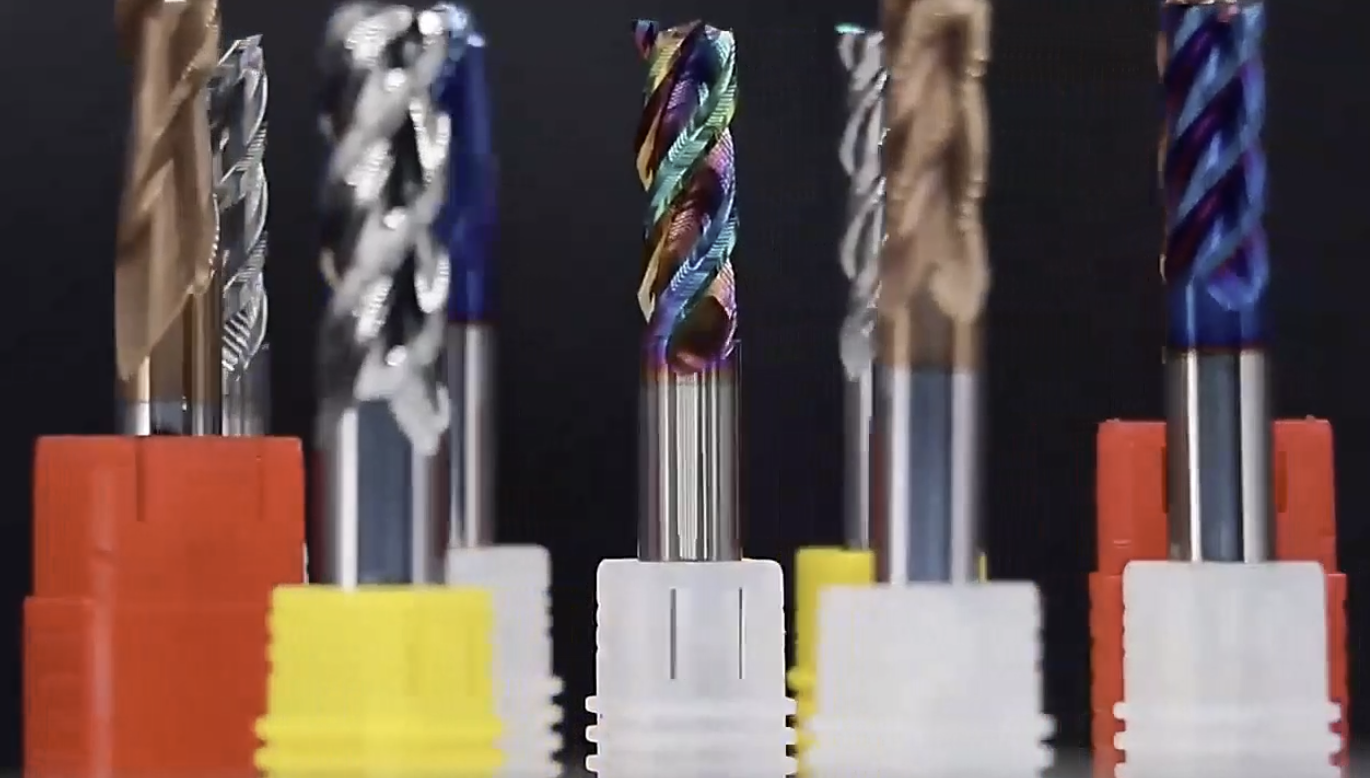
If you’ve ever experienced premature tool failure, chipped cutting edges, or poor surface finishes in CNC machining, the culprit might not be your feed rate or spindle speed—it could be the sharp corner on your end mill.
In precision machining, a corner radius end mill is a game-changer. Unlike a square end mill with a sharp 90° edge, a corner radius end mill features a reinforced, rounded edge at the intersection of the flute and the end face. This seemingly small design change dramatically improves tool strength, extends tool life, and allows for higher machining parameters.
At Hiboo Tools, we’ve spent years engineering carbide end mills that balance sharpness with durability. In this guide, we’ll walk you through everything you need to know about corner radius end mills—from standard sizes and types to when and how to use them—so you can optimize your machining process with confidence.
Key Takeaways
| Key Insight | Why It Matters |
| Corner radius strengthens cutting edges | Reduces chipping and increases tool life by 2–5x compared to square end mills in many applications. |
| Selection depends on material & operation | Roughing, finishing, and hard materials each require different radius sizes and flute counts. |
| Standard sizes save time & cost | Common radii like 0.2mm, 0.5mm, 1.0mm, 2.0mm are readily available and balance performance. |
| Radius affects surface finish | A larger radius can improve surface finish but may require careful toolpath planning. |
| Proper application prevents failure | Using the wrong radius for your operation leads to deflection, chatter, or premature wear. |
What Is a Corner Radius End Mill? A Clear Definition
A corner radius end mill is a cutting tool where the sharp corner between the bottom cutting edge and the side flute is replaced with a defined radius (R). This rounded corner distributes cutting forces more evenly, reducing stress concentration that typically causes micro-chipping in square end mills.
Corner Radius vs. Square End vs. Ball End Mill
| Tool Type | Corner Shape | Best For | Limitation |
| Square End Mill | Sharp 90° corner | Precision profiling, sharp internal corners | Prone to chipping at high feed rates |
| Ball End Mill | Hemispherical tip | 3D contouring, complex surface machining | Not ideal for flat surfaces or sharp edges |
| Corner Radius End Mill | Rounded corner | Roughing, finishing, high-speed machining; balances strength and geometry | Cannot create sharp internal corners |
The corner radius end mill is the ideal compromise: it retains the ability to create flat bottoms and vertical walls like a square end mill while offering significantly improved edge strength similar to a ball end mill.
Why Use a Corner Radius End Mill? The Key Benefits
1. Increased Tool Life
The radius eliminates the stress riser at the corner. In high-speed machining or hard materials (like stainless steel or titanium), a sharp corner is the first point of failure. A corner radius end mill can last 2 to 5 times longer in these conditions.
2. Higher Feed Rates
With a stronger edge, you can increase chip load per tooth without risking catastrophic failure. This directly translates to shorter cycle times and higher productivity.
3. Improved Surface Finish
The rounded edge produces a smoother transition between passes, reducing step marks and improving the quality of the machined surface.
4. Versatility
It works for both roughing and finishing operations. Many shops use a corner radius end mill for semi-finishing and finishing in one tool, reducing tool changeovers.
Sizes of Corner Radius End Mills: Standard Dimensions
Selecting the correct size involves both the cutting diameter and the corner radius. Below are common industry standards.
Standard Corner Radius Sizes by Cutting Diameter
| Cutting Diameter (mm) | Common Corner Radii (mm) | Typical Applications |
| 3 – 6 | 0.2, 0.3, 0.5, 1.0 | Precision molds, aerospace details, finishing |
| 8 – 12 | 0.5, 1.0, 1.5, 2.0 | General machining, die/mold roughing |
| 16 – 20 | 1.0, 2.0, 3.0, 4.0 | Heavy roughing, large part finishing |
Pro Tip: The corner radius should never exceed the depth of cut in a single pass, as this can cause excessive tool deflection.
Types of Corner Radius End Mills by Flute Count & Coating
The choice of flute count and coating is as critical as the radius itself.
By Flute Count
2-Flute Corner Radius End Mill – Best for aluminum and non-ferrous materials. Large chip evacuation space allows for high material removal rates.
4-Flute Corner Radius End Mill – The most common type for steel, stainless steel, and hardened materials. Provides better surface finish and rigidity.
3-Flute & Multi-Flute (5-7) – Used for high-feed machining, finishing in hard materials, and specialized applications like titanium alloys.
By Coating
| Coating Type | Properties | Ideal Materials |
| Uncoated | Economical, sharp edge | Plastics, aluminum (low adhesion risk) |
| AlTiN / TiAlSiN | High heat resistance, high hardness | Hardened steel, stainless steel, titanium |
| TiSiN | Excellent oxidation resistance, high hardness | High-temp alloys, dry machining |
| ZrN | Low friction, non-ferrous compatibility | Copper, brass, aluminum |
At Hiboo Tools, our corner radius end mills are manufactured with imported tungsten carbide rods and coated with advanced nano-layers to maximize performance in demanding applications.
When to Use Which Corner Radius: Selection by Application
1. Roughing Operations
Recommended Radius: 1.0mm – 3.0mm
Reason: Larger radii distribute cutting forces over a broader area, allowing for higher chip loads and reducing the risk of edge chipping.
Flute Count: 4–6 flutes for steel; 3 flutes for aluminum.
2. Finishing Operations
Recommended Radius: 0.2mm – 1.0mm
Reason: A smaller radius maintains sharpness for detail work while still providing enough strength for high-speed finishing passes.
Flute Count: 4–5 flutes for best surface finish.
3. Hard Materials (HRC 45–65)
Recommended Radius: 0.5mm – 2.0mm
Reason: The radius prevents micro-chipping in hardened steel, and a robust coating (like AlTiN) is essential.
Flute Count: 4–6 flutes with high helix angles.
4. Non-Ferrous & Aluminum
Recommended Radius: 0.2mm – 1.0mm
Reason: Sharp, polished flutes with a small radius reduce built-up edge while providing enough edge strength for high-speed machining.
Flute Count: 2–3 flutes with polished chip grooves.
Technical Considerations: How to Optimize Your Toolpath
Using a corner radius end mill isn’t just about the tool—toolpath strategy matters.
Stepover Optimization: A larger corner radius allows for increased radial engagement. For finishing, keep stepover ≤ 5% of the cutting diameter for best surface quality.
Avoid Sharp Internal Corners: If your part requires a sharp internal corner (90°), you must either use a square end mill or incorporate a relief area. A corner radius tool cannot create a sharp inside angle.
Use Adaptive or Trochoidal Milling: This strategy takes advantage of the tool’s strength by maintaining constant chip load and reducing radial engagement, ideal for corner radius end mills.
Common Mistakes to Avoid
Choosing Too Large a Radius – Can cause poor surface finish if the stepover isn’t adjusted properly.
Using a Square End Mill in High-Stress Applications – Leads to premature failure; switch to a corner radius end mill for better durability.
Ignoring Tool Deflection – Longer reach tools with large radii can deflect. Always check length-to-diameter ratios (≤4:1 recommended).
Mismatched Coating – Using a non-heat-resistant coating on hardened steel will destroy the tool quickly.
FAQ:
Q1: What’s the difference between a corner radius end mill and a ball nose end mill?
A: A corner radius end mill has a flat bottom with rounded corners, ideal for flat surfaces and walls. A ball nose end mill has a hemispherical tip, designed for 3D contours and curved surfaces.
Q2: Can I use a corner radius end mill for finishing?
A: Yes. With the right radius size (typically 0.2mm–1.0mm) and fine stepover, it produces excellent surface finishes while offering more durability than a square end mill.
Q3: How do I choose the right corner radius size?
A: Consider your material, operation (roughing vs. finishing), and the smallest internal radius your part allows. Larger radii = stronger tool; smaller radii = sharper detail.
Q4: Does a larger corner radius reduce cutting forces?
A: Yes. The radius distributes forces more evenly, reducing peak stress on the tool edge. This often allows for higher feed rates without increasing tool wear.
Q5: Are corner radius end mills more expensive than square end mills?
A: They are often comparable in price. Given their extended tool life and higher productivity, they typically offer a lower cost-per-part in most applications.
Conclusion & Why Hiboo Tools
Choosing the right corner radius end mill is one of the most effective ways to improve tool life, increase machining efficiency, and achieve better part quality. By understanding the relationship between radius size, flute count, coating, and application, you can make informed decisions that directly impact your shop’s bottom line.
At Hiboo Tools, we combine 20 years of manufacturing experience with advanced CNC grinding technology (Anca, Walter) and high-quality tungsten carbide raw materials. Whether you need standard corner radius end mills or customized solutions for complex applications, we deliver precision tools engineered for consistency and performance.
Explore our full range of corner radius end mills and other cutting tools at www.hiboo-tools.com. For expert guidance or custom tooling needs, contact our team—we’re here to help you machine smarter.
 English
 العربية
 Français
 Русский
 Español
 Português
 Deutsch
 italiano
 日本語
日本語 한국어
한국어 Nederlands
 Tiếng Việt
 ไทย
ไทย Polski
 Türkçe
 ພາສາລາວ
 ភាសាខ្មែរ
 Bahasa Melayu
 ဗမာစာ
ဗမာစာ Filipino
 Bahasa Indonesia
 magyar
 Română
 Čeština
 Монгол
 қазақ
қазақ Српски
 हिन्दी
 فارسی
فارسی Slovenčina
 Slovenščina
 Norsk
Norsk Svenska
 українська
 Ελληνικά
 Suomi
Suomi Հայերեն
 עברית
עברית Latine
 Dansk
Dansk বাংলা
বাংলা Hrvatski
 Gaeilge
 Oʻzbekcha
 latviešu
 Беларуская мова
 Български
 Lietuvių
 Gaelo Albannach
 ئۇيغۇرچە
 Cymraeg


