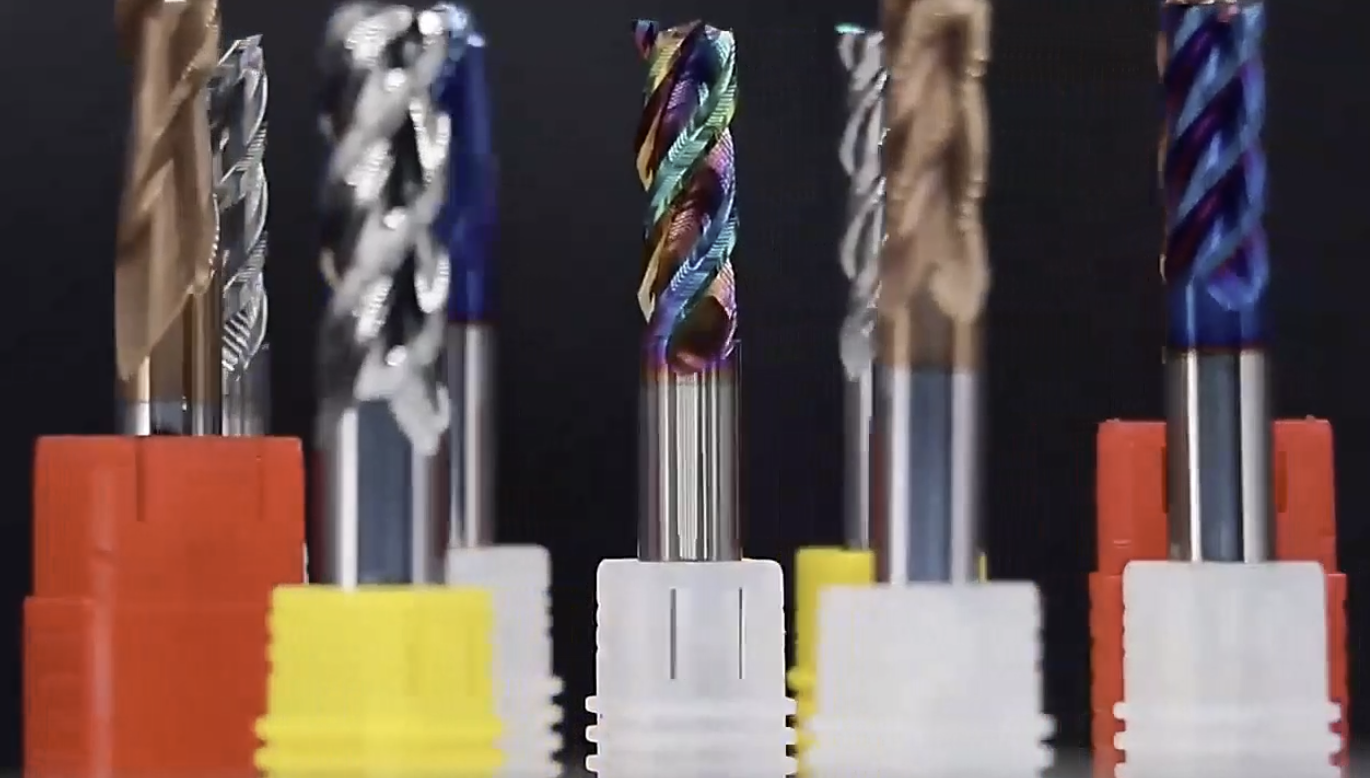
CNC milling is the core process of modern precision manufacturing, widely adopted in automotive, aerospace, mold making, 3C electronics and general mechanical processing. Among all CNC cutting tools, end mills stand out as the most versatile and essential equipment. Different from ordinary drilling tools, end mills feature cutting edges on both the end face and peripheral sides, enabling multi-direction cutting to complete complex machining tasks.
This comprehensive guide elaborates on the definition, classifications, core parameters, selection skills and complete production process of end mills. All content is combined with the practical production experience of Hiboo Tools, a professional manufacturer dedicated to high-precision solid carbide end mills and customized CNC cutting tools. Whether you are a machining engineer, workshop operator or procurement specialist, you can find professional and practical references here.
2. What Is an End Mill?
An end mill is a rotary cutting tool equipped with a cylindrical shank and spiral flutes, specially designed for milling machines and CNC machining centers. Driven by high-speed rotation, it removes excess material from workpieces to form various shapes. Its flexible cutting performance makes it irreplaceable for slotting, profiling and cavity machining.
End Mill vs Drill Bit
Many beginners confuse end mills with drill bits. The two tools differ greatly in structure, cutting logic and application scenarios.
Comparison Item
End Mill
Drill Bit
Cutting Direction
Cuts axially and radially
Only cuts axially (vertical direction)
Main Structure
Multiple spiral flutes, side cutting edges
Central drill tip, mainly end cutting edges
Core Function
Slotting, profiling, face milling, 3D contouring
Drilling round holes only
Machining Range
Complex shapes, grooves, curved surfaces
Standard circular through holes and blind holes
Working Trajectory
Flexible lateral movement + vertical feed
Fixed vertical penetration
Simply put, drill bits are made for hole drilling, while end mills are designed for overall workpiece shaping.
3. What Are End Mills Used For? Main Applications
End mills can realize almost all conventional milling operations, and are compatible with a wide range of workpiece materials.
Main Machining Operations
Profile milling: Process outer outlines and irregular shapes
Slotting & keyway cutting: Fabricate various grooves and keyways
Face milling: Smooth flat surfaces of workpieces
Pocket milling: Machine internal cavities and recesses
Contour milling: Create 3D curved surfaces for molds and parts
Chamfering and engraving: Finish edge treatment and fine pattern carving
Applicable Workpiece Materials
Carbon steel, alloy steel, hardened mold steel, stainless steel, cast iron, aluminum alloy, copper, titanium alloy, engineering plastics and composite materials. Hiboo Tools provides targeted end mill solutions for different material characteristics.
4. End Mill Materials: Solid Carbide vs. HSS
Tool material directly decides hardness, heat resistance, cutting speed and service life. The two mainstream materials for end mills are solid carbide and high-speed steel (HSS).
4.1 Solid Carbide End Mills
Solid carbide, also known as tungsten carbide alloy, is the preferred material for high-performance CNC end mills.
High hardness up to HRA 90, excellent rigidity and wear resistance
Outstanding high-temperature resistance, keeps sharp edges under high-speed cutting
Supports high cutting speed and feed rate, greatly improving production efficiency
Ideal for mass production, high-precision machining and hard material processing
Hiboo Tools adopts ultra-fine grain carbide raw materials, and its carbide end mills stably machine workpieces within HRC 65 hardness.
4.2 High-Speed Steel (HSS) End Mills
HSS is a traditional and cost-effective tool material for general machining.
Good toughness, not easy to chip or break under impact
Low cost and easy to regrind for repeated use
Limitations: Lower hardness, poor heat resistance, not suitable for high-speed cutting
It is widely used in low-rigidity equipment, small-batch production and prototype processing.
Selection Suggestion
Choose solid carbide end mills for formal CNC production, hard materials and high-efficiency requirements. Choose HSS end mills for low-budget, temporary processing and low-speed equipment.
5. Common Types of End Mills
According to tip shape, flute design and functional orientation, end mills are divided into multiple mainstream types to match different machining demands.
Square End Mills: With 90° flat tips, used for square shoulders, flat-bottom slots and side milling. It is the most universal type in workshops.
Ball Nose End Mills: Adopts round arc tips, perfect for 3D contouring, mold cavity processing and curved surface finishing.
Corner Radius End Mills (Bull Nose): Reinforced round corners reduce edge chipping, balancing roughing and finishing performance.
Roughing End Mills: With serrated flute design, splits chips effectively for high material removal rate in heavy roughing work.
Up-cut & Down-cut End Mills: Up-cut design discharges chips upward; down-cut design ensures smooth top surface for thin plates and laminates.
Straight Flute End Mills: Zero helix angle, avoids material fraying when processing composite materials.
Micro End Mills: Ultra-small diameter design from 0.1mm to 10mm, applied to precision machining of 3C electronic tiny parts.
6. Key End Mill Parameters
Mastering core parameters helps you select and use end mills more reasonably.
6.1 Flute Count
Flute number affects chip evacuation, tool rigidity and surface finish.
2 flutes: Large chip space, excellent for aluminum alloy and slotting
3 flutes: Balanced performance for general medium-load machining
4 flutes: High rigidity, smooth cutting finish, suitable for steel finishing
6/8 flutes: Super high rigidity, dedicated to high-hardness material precision finishing
Rule: Fewer flutes = better chip removal; More flutes = higher rigidity and better surface finish.
6.2 End Mill Coatings
PVD coating forms a protective layer on the tool surface to reduce friction and resist high temperature. Hiboo Tools provides multiple professional coatings:
AlTiN / TiAlN: Universal coating for carbon steel, alloy steel and mold steel
TiSiN: Ultra-high temperature resistance for high-speed continuous cutting
TiN: Cost-effective coating for general HSS and standard carbide tools
Special anti-sticking coating: Customized for aluminum and non-ferrous metals to avoid chip adhesion
6.3 Helix Angle
Helix angle refers to the tilt angle of cutting flutes:
Low helix angle: High rigidity, suitable for heavy roughing
Standard helix angle: Balanced cutting force, the most widely used type
High helix angle: Smooth cutting, reduces workpiece burrs, ideal for finishing
6.4 Basic Dimensions
Cutter diameter, cutting length and overall length determine the machining range and tool rigidity. Always choose the shortest cutting length to prevent vibration.
7. How to Make an End Mill: Full Manufacturing Process
High-precision end mills require strict production procedures and precision equipment. The complete manufacturing process adopted by Hiboo Tools is as follows:
Raw Material Cutting: Select qualified carbide rods or HSS blanks, cut into standard lengths according to design drawings.
Rough Grinding: Use high-precision CNC tool grinders to form basic flute shape and shank size.
Finish Grinding: Accurately grind flutes, helix angles and cutting edges to ensure micron-level dimensional tolerance.
Tip Machining: Process square, ball nose or corner radius tips, guaranteeing concentricity and symmetry.
PVD Coating: Conduct vacuum coating treatment to enhance wear resistance and high-temperature performance.
Full Inspection: Detect diameter, runout, angle and length with professional measuring instruments; unqualified products are eliminated directly.
Cleaning & Packaging: Remove grinding residues, then pack tools properly to avoid damage during transportation.
Every procedure follows strict quality standards to ensure stable tool performance.
8. Advantages of Hiboo Tools End Mills
As a professional end mill manufacturer, Hiboo Tools has core competitive advantages in raw materials, production and service:
Premium Raw Materials: Adopts imported ultra-fine grain carbide, with uniform internal structure and stable hardness.
Advanced Equipment: Equipped with international top CNC grinding machines, ensuring high machining precision.
Diversified Coatings: Matches exclusive coating solutions for different workpieces to extend tool life by 30%+ compared with ordinary products.
Complete Product Line: Covers standard square, ball nose, roughing and micro end mills, supporting one-stop procurement.
Strict Quality Control: 100% full inspection before delivery, zero tolerance for defective products.
Custom Service: Supports non-standard size, special angle and composite blade customization for special machining demands.
9. How to Choose the Right End Mill
Follow the steps below to pick the most suitable end mill for your project:
Confirm the material and hardness of the workpiece.
Clarify the machining type: roughing, finishing, slotting or contouring.
Check the rigidity, maximum speed and cooling condition of your CNC machine.
Select reasonable tool diameter, cutting length and flute count.
Match professional coating according to workpiece characteristics.
Roughing vs Finishing Selection
For Roughing: Prioritize chip removal efficiency. Choose 2–3 flutes, large chip space and low helix angle end mills; adopt roughing teeth design for heavy stock removal.
For Finishing: Prioritize surface finish and precision. Choose 4+ flutes, high helix angle and coated end mills to reduce burrs and vibration.
10. End Mill Usage, Maintenance & Storage
Standard use and maintenance can effectively extend the service life of end mills.
Set matched spindle speed and feed rate, do not overload cutting.
Use sufficient coolant during high-speed cutting to lower temperature and reduce chip adhesion.
Clamp the tool firmly to avoid excessive runout caused by loose installation.
After use, clean chips and oil stains on the tool surface in time.
Store end mills in special tool boxes separately to prevent collision and edge damage.
Carbide end mills can be reground 3–6 times after wear for secondary use.
11. Common Usage Mistakes & Troubleshooting
In daily machining, improper operation is the main cause of tool damage and poor workpiece quality. Here are common problems and solutions:
11.1 Common Operational Mistakes
Excessive tool overhang: Causes vibration, resulting in poor surface finish and tool breakage. Solution: Shorten the cutting length as much as possible.
Unmatched speed and feed: Too fast speed leads to tool burning; too large feed causes edge chipping. Solution: Refer to the parameter table for matching settings.
Insufficient coolant: Leads to high temperature and chip welding. Solution: Increase coolant flow and adjust spray direction.
Wrong flute selection: Use multi-flute tools for deep slotting, resulting in poor chip evacuation. Solution: Select fewer flutes for deep slot processing.
11.2 Machining Defects & Troubleshooting
Workpiece with obvious burrs: Caused by dull cutting edges or unreasonable helix angle. Replace tools or switch to high helix end mills.
Tool rapid wear: Wrong coating or overloaded cutting. Change targeted coating and reduce cutting load.
Dimensional deviation: Caused by tool runout or machine vibration. Re-clamp the tool and check equipment stability.
12. FAQ
Q1: What is the main difference between 2-flute and 4-flute end mills?
A: 2-flute end mills have larger chip space, better for slotting and aluminum processing. 4-flute end mills have higher rigidity and better finish, suitable for steel finishing.
Q2: Can solid carbide end mills be reground after wearing?
A: Yes. Professional reginding can restore cutting performance, and qualified carbide end mills can be reused many times.
Q3: Which coating works best for stainless steel?
A: AlTiN or TiSiN coating is recommended for stainless steel, which resists high temperature and chip adhesion effectively.
Q4: What type of end mill is used for 3D mold contouring?
A: Ball nose end mills are the standard choice for 3D curved surface and mold contour machining.
Q5: Are HSS end mills cheaper than carbide end mills?
A: Yes. HSS end mills have lower cost, but shorter service life and lower cutting efficiency compared with carbide products.
13. Conclusion
End mills are fundamental tools for CNC milling processing. A clear understanding of their definition, types, parameters and production process is the premise of efficient and low-cost machining. Reasonable selection, standard use and scientific maintenance can maximize tool performance and create greater value for production.
As a reliable global end mill manufacturer, Hiboo Tools adheres to high-standard production and strict quality control. We provide a full range of standard end mills and professional customized tools, serving customers in various manufacturing industries worldwide.
14. Contact & Custom Solutions
If you have demands for standard end mill procurement, parameter consultation or non-standard tool customization, feel free to contact the professional team of Hiboo Tools. We will provide you with one-stop cutting tool solutions, technical support and after-sales service.
 English
 العربية
 Français
 Русский
 Español
 Português
 Deutsch
 italiano
 日本語
日本語 한국어
한국어 Nederlands
 Tiếng Việt
 ไทย
ไทย Polski
 Türkçe
 ພາສາລາວ
 ភាសាខ្មែរ
 Bahasa Melayu
 ဗမာစာ
ဗမာစာ Filipino
 Bahasa Indonesia
 magyar
 Română
 Čeština
 Монгол
 қазақ
қазақ Српски
 हिन्दी
 فارسی
فارسی Slovenčina
 Slovenščina
 Norsk
Norsk Svenska
 українська
 Ελληνικά
 Suomi
Suomi Հայերեն
 עברית
עברית Latine
 Dansk
Dansk বাংলা
বাংলা Hrvatski
 Gaeilge
 Oʻzbekcha
 latviešu
 Беларуская мова
 Български
 Lietuvių
 Gaelo Albannach
 ئۇيغۇرچە
 Cymraeg