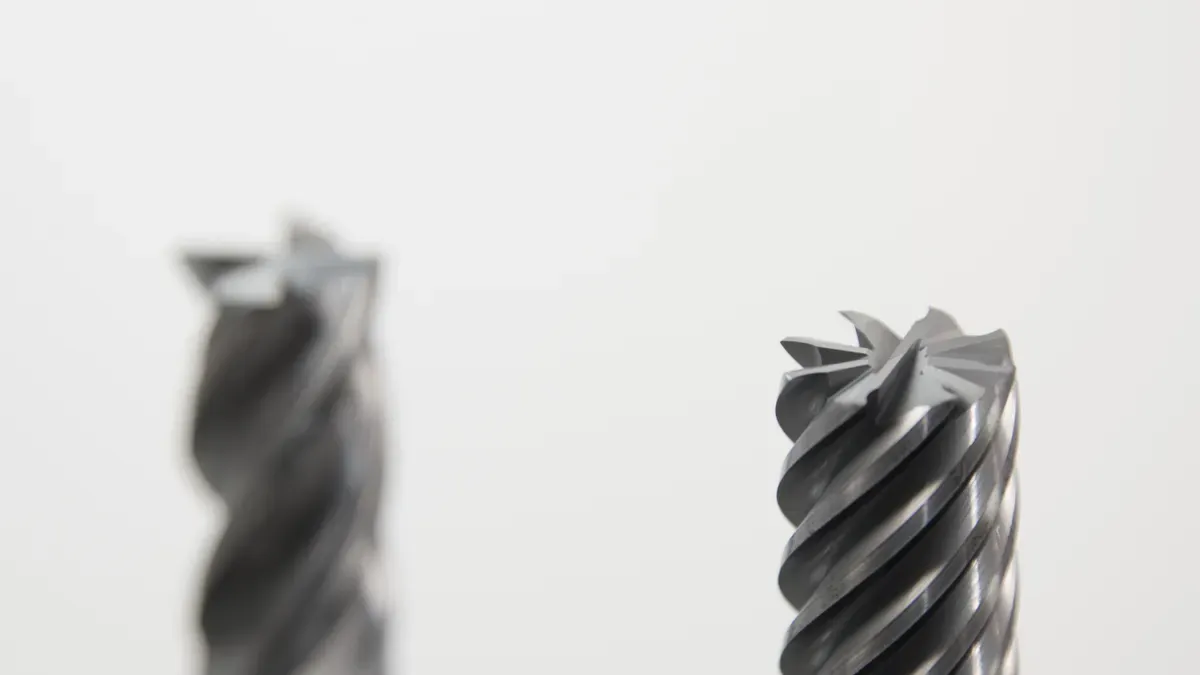
You need the correct end mill for your precision machining projects. HRC55 end mills offer strong impact resistance for pre-hardened steels and flexible cutting tasks. HRC60 end mills provide the best balance of wear protection and strength for general mold work, making hrc60 a standard choice in the industry. Meanwhile, HRC65 end mills offer higher wear resistance and stable edge performance for demanding finishing operations. Suitable workpiece hardness depends on tool design, coating, and machining conditions—not the HRC rating alone. Choosing the right end mill depends on metal hardness, machine stability, spindle wobble, and cutting settings. Picking a cutter that is too hard on a shaky setup leads to brittle edge chipping. On the other hand, choosing a tool that is not hard enough causes fast wear on tough parts.
Key Takeaways
Choose an end mill based on the workpiece material, hardness, tool design, and machining conditions—not the tool’s HRC rating alone.
HRC55, HRC60, and HRC65 end mills offer increasing hardness and wear resistance but decreasing toughness. Higher HRC does not mean higher machining capability; the right hardness depends on the workpiece, cutting conditions, and balance between wear resistance and toughness.
As a practical reference, the tool hardness is often around 20 HRC higher than the workpiece hardness, but this is not an absolute rule.
Tool geometry, coating, flute design, cutting parameters, machine rigidity, and spindle runout also affect machining performance and tool life.
Keep the setup rigid and runout low to reduce edge chipping and improve end mill life.
You need to check tungsten carbide material features when picking tools for precise jobs. Making good tools requires a fair mix of center hardness and bending strength. Stronger hardness stops surface scraping and wear during fast cutting runs. Yet, super hard materials lose shock resistance, raising the chance of tip chips under heavy pressure. Knowing this basic balance helps you stop sudden tool breaks while keeping a smooth metal finish. Every cutting job needs a special mix of core toughness and outer wear protection to avoid early tool damage.
Substrate Micrograin and Hardness Trade-offs
Choosing the right base material directly shapes tool strength during tough jobs. Tool makers tweak cobalt levels and grain sizes to get special physical traits for cutting tough metals. Shrinking grain size to tiny levels boosts hardness, but it lowers strength unless workers tune the glue binder. Good binder balance stops small air gaps during heating, which is vital when cutting very hard metals. You should see how binder placement protects tool edges against hard hits.
For small precise tools, tiny grain carbide types (grain size under 0.5 μm) with well-placed cobalt are best. Keeping a steady tiny grain build stops uneven wear and holds exact shape, which works well for HRC65 end mills cutting hard metals.
You can see this simple trade-off in normal tungsten carbide mixes:
Carbide type
Hardness (HRA)
TRS (MPa)
Fine-grain WC-Co (6% Co)
92-93
1,800-2,400
Medium-grain WC-Co (10% Co)
89-91
2,500-3,000
Coarse-grain WC-Co (15% Co)
Not stated
2,800-3,200
Medium-grain blends bring high bending strength to soak up big hits during rough cuts. Fine-grain blends give more outer strength to help tools last longer during hard metal cutting. Tiny-grain bases give an hrc65 cutter the edge firmness needed when carving metal from fully hardened blocks. When picking an end mill, matching grain size to metal hardness ensures smooth cuts and long tool life.
PVD Coatings and Thermal Red-Hardness
Physical Vapor Deposition covers build a vital heat shield over the inner tool base. Modern PVD shields like Aluminum Titanium Nitride and Black Nano keep edges sharp during hot dry rubbing. These smart nano-layers hold great heat strength when temperatures rise, blocking air damage and base rusting. Strong heat protection saves the cutting tip when heavy rubbing creates high heat during fast cuts.
Picking the best tool type means matching base grains, shield types, and metal traits together:
HRC55 Cutters: Offer good toughness and versatility for general-purpose machining, with performance depending on the tool design and cutting conditions.
hrc60 Cutters: Provide a good balance of toughness and wear resistance, making them a versatile choice for mold machining.
hrc65 Cutters: Deliver higher wear resistance and are well suited to demanding finishing work and harder materials. However, the HRC65 rating should not be taken as a direct match for 65 HRC workpieces.
As a practical starting point, the suitable workpiece hardness is often significantly lower than the tool grade, with a difference of around 20 HRC sometimes used as a reference. However, this is not a fixed rule and should always be evaluated together with tool geometry, coating, machine rigidity, and cutting parameters.
Selecting an hrc60 end mill boosts tool life and keeps part quality high across normal mold jobs. You get the best results when substrate strength, coating, tool geometry, and cutting conditions are properly matched to the application.
HRC55 End Mills: Features and Versatility
Hiboo HRC55° Square End Mills Capabilities
Changzhou Hiboo Tools Co., Ltd sets a top market standard by crafting tough carbide cutters for long-lasting, flexible shop work. Hiboo HRC55° Square End Mills combine tiny-grain bases with a dark nano layer to increase surface protection. This strong cutting tool design includes two or four twisted flutes, a smooth round handle, and a right-side cut direction. Two center-crossing edges allow easy plunging and safe entry during deep slot milling and side shaping jobs.
The flat bottom design makes smooth level faces, crisp steps, and sharp square corners on every cut pass. Straight cutting sides move metal fast while preventing tool bending under big pressure loads. Skilled workers choose smaller tool sizes to get very tight fits in accurate groove cutting jobs. Good tiny-grain bases help these end mills keep sharp edges through long factory jobs.
You can use these flexible tools across many shop tasks without losing edge life. Machine operators set cutting speeds using specific metal traits to improve part smoothness and chip movement.
A series rating such as HRC55 is a product classification that reflects the tool's intended performance characteristics and design. It should not be interpreted as a direct one-to-one indication of either the tool's actual hardness or a fixed workpiece hardness range.
These tools perform well when machining pre-treated steels, stainless steel, cast iron, aluminum, and other non-ferrous or relatively soft metals. When cutting pre-hardened steels, proper cutting speeds and feeds are essential for controlling heat and reducing premature edge wear. The right end mill should be selected based on the workpiece material, hardness, tool geometry, and machining conditions to deliver reliable performance in slotting, side milling, and other demanding operations.
HRC60 End Mills: Precision Machining Sweet Spot
Mold and Die Milling Efficiency
Machine shops often use HRC60 end mills for mold machining that requires a balance of toughness, wear resistance, and cutting efficiency. These HRC60 end mills are commonly selected for medium- to relatively high-hardness steels, but the appropriate workpiece hardness depends on factors such as tool geometry, coating, cutting conditions, and machine rigidity.
Mold makers use HRC60 end mills for pocketing, slotting, profiling, and other precision machining operations. With the right tool design and stable machine setup, they can help reduce premature edge wear and chatter during demanding cuts. Their balanced performance makes them a practical choice for long production runs where consistent surface quality, dimensional accuracy, and tool life are important.
Geometry for Medium-Hard Steels
Tool designers build special hrc60 end mills to handle tough metal cutting jobs. The strong center core gives high edge strength against bending during deep cuts. A thicker tool core adds extra stability under heavy cutting forces. Solid micrograin carbide bases soak up light cutting shaking on hard metals easily. This smart design prevents quick edge chipping when milling hard steel parts.
Matching core geometry and structural stability to material hardness optimizes every production cycle.
Smart tool choices rely directly on your machine setup and metal traits. Modern hrc60 shapes control focused heat build-up during dry cutting work. The smooth flute edge design reduces rubbing wear on hard metal surfaces. An hrc60 end mill delivers steady performance when cutting high-hardness steel parts. You can achieve reliable accuracy when the end mill, workpiece material, and machining conditions are properly matched.
HRC65 end mills are often selected for demanding finishing operations involving hardened steels and other wear-intensive applications. Basic cutters break down fast on these very tough metal parts. Tool makers design specialized hrc65 solid carbide end mills for high-performance applications on fully hardened stock. These tools use extra core stiffness to stop bending under strong cutting loads. You rely on this exceptional structural stability to maintain tight dimensions during deep profiling passes.
Parameter
Substrate Specification
Recommended Workpiece
Depends on tool design and machining conditions
Substrate Grain Size
0.4 to 0.6 μm ultrafine WC-Co
Substrate Hardness
HV 1800 to 2200
Cobalt Content
10% Co
Flexural Strength
4300 N/mm²
The ultrafine carbide base gives top stability at the outer cutting edge. This fine substrate resists thermal chipping and abrasive flank wear during high-hardness machining. Advanced PVD coatings shield the sharp tool geometry from rapid friction heat. The updated edge shape keeps the cutting tip strong through long finishing jobs on hard steel.
High-Speed Finishing Requirements
Cutting hardened steel generates significant heat and cutting forces, so HRC65 end mills require carefully controlled machining parameters. Cutting speed (Vc) is typically expressed in m/min, while feed rate (Vf) is usually measured in mm/min. The optimal settings should be determined based on the workpiece material and hardness, tool geometry, coating, tool diameter, and machine rigidity.
Cutting Parameter
Recommended Setting
Cutting Speed (Vc)
Refer to the tool manufacturer's recommendations; often expressed in mm/min
Feed Rate (Vf)
Set according to tool diameter, flute count, and feed per tooth; typically expressed in mm/min
Axial Depth (ap)
≤ 0.5×D
Entry Method
Ramp-in ≤3° or helical interpolation
High-speed finishing techniques lower physical shock on your hrc65 tools. Light side cuts stop heavy tool chatter while preserving edge stability. A firm setup ensures smooth spindle rotation and stops bad shaking. Your hrc65 end mills deliver clean surface finishes and steady cutting performance on hardened steel dies. Correct settings extend tool life and make hrc65 end mills essential for demanding shop applications.
Precision Setup and Choosing the Right End Mill
Runout Control and Toolholder Rigidity
High machine stability helps you complete hard-metal cutting jobs. Special holders like hydraulic or shrink-fit chucks shield tools from bad shaking. Solid CNC bases keep the cutter steady during heavy cuts and fast passes. Keep spindle wobble under 0.005 mm to protect sharp edges from chipping early. Large wobble puts all cutting forces onto just one flute. Unbalanced loads cause fast tool damage during tough cutting tasks.
Good machine setup cuts shaking and protects tool stability during long jobs. Changzhou Hiboo Tools Co., Ltd uses top Zoller devices for strict quality testing. These detailed checks verify tool sizes, corner curves, and tight center alignments. Careful checks ensure reliable shapes and steady tool strength for every solid carbide tool. Pairing accurate shapes with steady machines improves cutting precision and extends tool life.
Troubleshooting Chipping vs Flank Wear
Bad choices or wrong machine settings cause fast tool damage during cutting jobs. Spotting tool failures fast helps fix shop issues and protect costly metal stock. Excessive flank wear may indicate that the tool's wear resistance or machining conditions are not well suited to the application. Edge chipping occurs when hard tools meet spindle shaking, fast feeds, or bad chip removal.
Failure mode
Selection link
Root cause
Recommended corrective actions
Flank wear
May occur when the selected end mill does not provide sufficient wear resistance for the workpiece material and machining conditions.
Excessive cutting speed, unsuitable tool geometry or coating, insufficient wear resistance, or demanding workpiece conditions
Review the workpiece material and hardness, cutting parameters, tool geometry, coating, and machine stability. Select a more suitable end mill design when necessary.
Micro-chipping
Occurs when the tool is excessively hard or brittle for the material
Spindle vibration; feed rate too high; poor chip evacuation causes re-cutting of chips
Inspect spindle runout; choose variable-helix geometry; use high-pressure air to clear chips
Pick the best end mill for every job by using this practical decision guide:
Evaluate the workpiece material and hardness first. Do not select an end mill based on the tool's HRC rating alone. HRC55, HRC60, and HRC65 end mills are designed with different balances of hardness, toughness, and wear resistance. As a practical reference, the suitable workpiece hardness is often lower than the tool's HRC rating by around 20 HRC, but the actual application also depends on tool geometry, coating, cutting conditions, and machine rigidity.
Check machine stability and spindle runout carefully. Higher-performance end mills with sharper cutting edges and higher wear resistance generally require better machine rigidity and lower runout. A stable setup helps reduce vibration, edge chipping, and premature tool wear.
Match the tool design to the machining operation. Consider flute count, helix angle, edge preparation, coating, and tool geometry when selecting an end mill for slotting, side milling, pocketing, or finishing. HRC60 end mills are often chosen for versatile mold machining, while HRC65 end mills can be suitable for demanding finishing operations when the workpiece and machining conditions are appropriate.
Consider production volume and performance requirements. For general and continuous machining, select a tool that provides the right balance between tool life, cutting efficiency, and cost. For higher-speed or more demanding finishing applications, choose a tool designed for greater wear resistance and stable performance.
Proper end mill selection depends on more than the hardness of the workpiece. Tool substrate, geometry, coating, edge design, machining strategy, machine rigidity, and cutting parameters all affect final performance. HRC55 end mills, such as Hiboo HRC55° Square End Mills, can provide a practical solution for general milling applications. HRC60 and HRC65 end mills offer different performance characteristics and should be selected according to the specific material and machining requirements.
For expert guidance on selecting the right solid carbide end mill for your application, contact Changzhou Hiboo Tools Co., Ltd. for recommendations based on your workpiece material, machining operation, and production requirements.
FAQ
What workpiece hardness is best for an hrc60 end mill?
An HRC60 end mill is commonly used for a wide range of mold steels and other demanding materials, but the tool's HRC rating should not be treated as a direct match for workpiece hardness. As a general reference, the suitable workpiece hardness is often lower than the tool's rated HRC value, while the actual application depends on tool geometry, coating, edge design, machining strategy, and cutting conditions. HRC60 tools typically provide a practical balance of toughness and wear resistance for versatile machining applications.
When should you choose an hrc65 end mill over lower grades?
Choose an HRC65 end mill when your application requires higher wear resistance and stable edge performance, particularly in demanding finishing operations. However, an HRC65 tool does not automatically mean it is suitable for machining 65 HRC material. In many applications, it may be more suitable for workpieces with significantly lower hardness, depending on the tool design and machining conditions. A rigid machine setup and controlled cutting parameters are also important for maximizing tool performance.
Why does spindle runout affect tool performance?
Excessive spindle runout creates uneven cutting loads between flutes, which can accelerate wear and cause premature edge chipping. This is especially important for precision solid carbide end mills with high-performance cutting edges. Keep runout as low as practical for the specific application, and use high-precision tool holders, such as hydraulic or shrink-fit holders, when tighter accuracy and stability are required.
What key factor guides end mill selection?
End mill selection should be based on a combination of workpiece material and hardness, tool substrate, geometry, coating, machining operation, cutting parameters, and machine rigidity. Tool HRC is only one reference factor and should not be used as the sole basis for matching an end mill to a specific workpiece hardness. A well-matched tool and machining setup can help reduce premature wear, edge chipping, and vibration while improving machining efficiency.
About The Author
Chenyang Zhang | Chief Engineer at Hongjian Tools
I’m Chenyang Zhang, Chief Engineer at Hongjian Tools. I oversee R&D, process optimization and quality control for solid carbide end mills, drills and other precision CNC cutting tools. Drawing on years of hands-on machining experience, I continuously optimize tool materials, cutting geometries and production workflows to develop stable, durable cutting tools for machining steel, stainless steel and aluminum. I started this blog to share practical advice on end mill selection, cutting parameter setup, and fixes for typical machining problems including tool chipping, chatter vibration, poor chip evacuation and unsatisfactory surface finishes. In my opinion, pairing the right cutting tools with proper machining strategies helps manufacturers improve productivity, prolong tool service life and cut overall production costs.
 English
 العربية
 Français
 Русский
 Español
 Português
 Deutsch
 italiano
 日本語
日本語 한국어
한국어 Nederlands
 Tiếng Việt
 ไทย
ไทย Polski
 Türkçe
 ພາສາລາວ
 ភាសាខ្មែរ
 Bahasa Melayu
 ဗမာစာ
ဗမာစာ Filipino
 Bahasa Indonesia
 magyar
 Română
 Čeština
 Монгол
 қазақ
қазақ Српски
 हिन्दी
 فارسی
فارسی Slovenčina
 Slovenščina
 Norsk
Norsk Svenska
 українська
 Ελληνικά
 Suomi
Suomi Հայերեն
 עברית
עברית Latine
 Dansk
Dansk বাংলা
বাংলা Hrvatski
 Gaeilge
 Oʻzbekcha
 latviešu
 Беларуская мова
 Български
 Lietuvių
 Gaelo Albannach
 ئۇيغۇرچە
 Cymraeg